Why Clear Communication Is What Patients Want Most
Key Takeaways
- Clear communication in healthcare helps patients understand their condition, treatment and next steps.
- Good communication goes beyond explaining a diagnosis; it involves listening, answering questions and confirming understanding.
- Language, cultural differences, psychological factors and differences in how patients and providers understand health conditions can all create communication barriers.
- Effective healthcare communication is a shared responsibility between patients and healthcare providers.

Introduction
Many patients have had this same experience. They sit across from their healthcare provider, constantly nodding their heads and saying, “Yes, Doctor.” Then the consultation ends, they collect their prescription, walk out of the hospital and head home. But somewhere between the hospital gate and home, the questions begin.
What exactly did the doctor say I have? How am I supposed to take this medicine? What happens if I miss a dose? When should I come back? Was I supposed to ask something else?
Beyond the information given, the question remains: was it actually understood? Because giving information is not the same as communicating clearly. Clear communication in healthcare is not simply about doctors explaining things. It is about ensuring that patients can understand, use and act on the information they receive.
And this is important because healthcare is rarely a one-way transaction. A patient is not simply handed a diagnosis or prescription and sent home. They are expected to understand what is happening, participate in decisions, follow instructions and know when to seek further help. But for that to happen, the conversation has to work through clear communication.
What Does Clear Communication in Healthcare Mean?
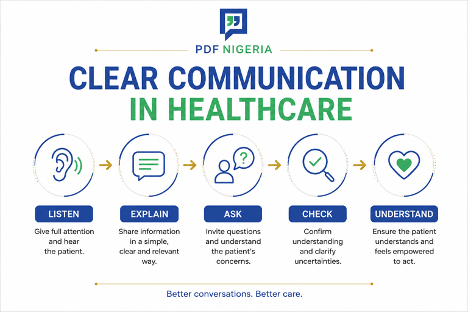
Beyond replacing complicated medical words with simpler ones, clear communication in healthcare means making important health information understandable, relevant and usable.
Effective communication involves more than speaking. It involves listening, explaining, encouraging questions and checking understanding. This is because health information can be complex, especially with patients who may be anxious, consultations which can be time-limited, and people who can have different languages, levels of education, culture and previous experiences with healthcare.
This is the reason the Agency for Healthcare Research and Quality recommends strategies such as plain language, active listening, open-ended questions, limiting information overload and encouraging patients to ask questions.
Beyond the Diagnosis: Why Do Patients Want Clear Communication?
A diagnosis can answer one question: “What is wrong?” But patients usually have several more questions. They want to know:
“What does this mean for me?”
Hearing the name of a condition doesn’t automatically tell someone what to expect. Patients may want to know how serious the condition is, what symptoms to look out for, and what could happen next.
“What am I supposed to do now?”
A treatment plan is only useful when the person receiving it understands how to follow it. This is especially important with medication. Patients may need clear instructions about how much to take, when to take it and what to do if they experience a problem. Agency for Healthcare Research and Quality notes that difficulty understanding when and how to take medicines can become a safety issue.
“What happens next?”
Patients need to know whether they should and when to return, when they should expect improvement, which symptoms should prompt them to seek further attention, and if they should seek a second opinion.
“Can I ask questions without feeling embarrassed?”
This may be one of the most overlooked parts of healthcare communication.
A patient may not ask a question because they are afraid it sounds foolish. They may worry about taking too much of the provider’s time. They may also assume that because the provider is the expert, they should simply listen.
But understanding should not be a test of how much medical language a patient already knows. A patient who says, “Please explain that again,” is not being difficult. They are simply trying to understand their healthcare. And research on communication supports the importance of involving patients in conversations about their care rather than treating communication as information delivered in only one direction.
Patients want clear communication because it gives them the knowledge and confidence to take an active, informed role in their healthcare.
Four Main Categories of Communication Barriers in Healthcare
Communication doesn’t fail for just one reason. A 2026 review published in the Journal of Medical Internet Research examined 253 studies on communication barriers in healthcare and identified four broad areas: linguistic, cultural, psychological, and mental-model differences. Other evidence also shows that the physical and healthcare environment can affect how well patients hear, understand, and engage with information.
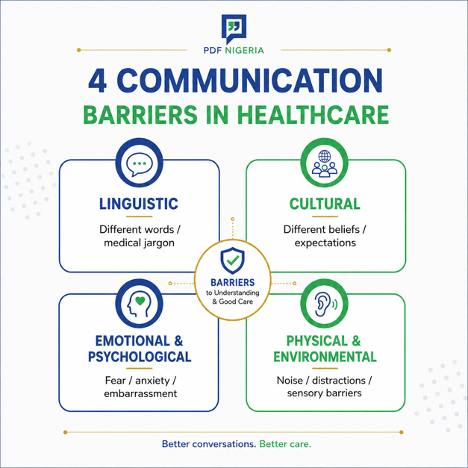
In this article, we’ll look at these barriers through four practical categories: linguistic, cultural, emotional and psychological, and physical and environmental barriers.
1. Linguistic Barriers
Sometimes the problem is simply language. A patient and healthcare provider may not share the same preferred language. Even when they do, medical terminology can create another layer of difficulty. Words that are ordinary to a healthcare professional can be unfamiliar to a patient.
2. Cultural Barriers
Culture can influence how people understand illness, communicate concerns, make decisions and respond to medical advice.
For example, family involvement, beliefs about illness and treatment, traditional health practices and expectations about healthcare relationships can all influence a conversation. It is recommended that providers learn from patients about the beliefs and customs that may affect their healthcare decisions rather than making assumptions.
3. Emotional and Psychological Barriers
Fear, anxiety, embarrassment, stigma, or previous negative experiences can make it difficult for patients to speak openly or absorb what they are told. At the same time, patients and healthcare providers may approach the same health problem from very different perspectives.
While the provider is thinking about the diagnosis and treatment plan, the patient may be thinking, Can I afford this treatment? Will I still be able to work? What does this mean for my family? Am I going to be okay? When these emotional concerns and differences in perspective are not addressed, important parts of the conversation can be missed or misunderstood.
4. Physical and Environmental Barriers
Communication can also fail because of the environment in which care takes place. Busy wards, alarms, interruptions, and conversations within earshot can make it difficult for patients to hear or concentrate on important information. Similarly, hearing or vision difficulties can make it harder for patients to receive and process information, particularly when appropriate aids or adjustments are not provided.
This is especially important because clear communication in healthcare is not determined by words alone. Patients need an environment that allows them to hear, see, focus, ask questions, and participate in the conversation
These four barriers often overlap, which is why improving communication requires more than simply telling healthcare providers to “speak plainly.”
Clear Communication Is a Shared Patient-Provider Responsibility
It is tempting to place the entire responsibility for communication on healthcare providers because they are the medical experts. And although healthcare professionals have an important responsibility to communicate clearly. But patients also have a role.

Healthcare providers can:
- use plain language where possible
- listen without unnecessarily interrupting
- invite questions
- explain unfamiliar medical terms
- prioritise the most important information
- check whether the patient understands
- explain what happens next
Patients can:
- ask questions
- speak honestly about their symptoms and concerns
- say when they don’t understand something
- clarify medication instructions
- mention other medicines or treatments they are using
- confirm their next steps before leaving
One particularly useful approach for healthcare professionals is teach-back: asking patients to explain in their own words what they understand they need to do. It isn’t a test of the patient’s intelligence. It is a way for the provider to check whether their own explanation was clear.
A systematic review of 20 studies found teach-back effective across a range of settings and outcomes, including knowledge recall and some health-related outcomes. In other words, better communication isn’t about finding someone to blame. It is about making the conversation work for both sides.
What Happens When Communication in Healthcare Fails?
When communication breaks down, the consequences can extend beyond a frustrating consultation. A patient may misunderstand a diagnosis, forget important instructions or use medication incorrectly. They may delay asking for help because they don’t know which symptoms matter. They may also leave the healthcare setting feeling unheard, anxious or unsure about what to do next.
The problem is particularly important because patients do not always remember everything they hear during a consultation. Research has found that patients can forget 40–80% of medical information immediately, while the amount remembered can decrease as more information is presented. This is particularly important during consultations, where patients may be receiving a diagnosis, treatment instructions, medication information and several other pieces of advice at once.
Poor communication can therefore affect more than patient satisfaction. It can influence understanding, participation, treatment decisions and, in some circumstances, patient safety. The 2026 scoping review similarly links communication barriers with outcomes in clinical decision-making, healthcare access, patient experience and safety.
Therefore, the solution isn’t to overwhelm patients with even more information. It is to communicate better.
Practical Tips for Improving Communication in Healthcare
For patients
- Prepare your questions before the appointment.
Write down what you want to ask so you don’t have to rely on memory during the consultation. - Don’t pretend to understand.
If a healthcare provider uses a term you don’t recognise, ask what it means. - Ask for clarification.
“Can you explain that in simpler terms?” is a perfectly reasonable question. - Repeat important instructions back to yourself.
Before leaving, make sure you know what medicine to take, how to take it and what you should do next. - Be honest.
Tell your healthcare provider about relevant symptoms, medications, treatments and concerns. Hiding information can make it harder for them to understand the full picture.

For healthcare providers
- Use plain language.
Medical terminology has its place, but not every explanation needs to sound like a textbook. - Listen before responding.
Patients often provide important information when they are given enough space to tell their story. - Invite questions.
Don’t assume silence means understanding. - Prioritise.
Agency for Healthcare Research and Quality recommends limiting information to key “need-to-know” or “need-to-do” points and reinforcing important information rather than overwhelming patients with too much at once. - Use teach-back.
Instead of asking, “Do you understand?”, try asking, “Just so I know I explained it clearly, can you tell me how you’ll take this medicine when you get home?” Evidence suggests teach-back can improve patient knowledge and self-management, although the strength of evidence varies across conditions and outcomes.
CONCLUSION
A healthcare conversation should not end with a patient nodding simply because they are too uncomfortable to say, “I don’t understand.” The goal isn’t for patients to leave the consultation knowing every medical term their provider used. Instead, the goal is for them to leave knowing what is happening, what they need to do, why it matters and when to seek further help.
That requires healthcare providers who are willing to explain, listen and check understanding. It also requires patients who feel safe enough to ask questions, speak honestly and participate in their care. Because patients shouldn’t have to choose between trusting their healthcare provider and understanding their healthcare. They deserve both.
Good healthcare requires good communication, and good communication begins when both sides are willing to understand each other.
References
Agency for Healthcare Research and Quality. (2024). Consider culture: Tool 10. U.S. Department of Health and Human Services. https://www.ahrq.gov/health-literacy/improve/precautions/tool10.html
Chowdhury, M. H., & Liu, Y. (2026). Communication barriers in patient-provider interactions in health care: Scoping review. Journal of Medical Internet Research, 28, e79744. https://doi.org/10.2196/79744
Talevski, J., Wong Shee, A., Rasmussen, B., Kemp, G., & Beauchamp, A. (2020). Teach-back: A systematic review of implementation and impacts. PLOS ONE, 15(4), e0231350. https://doi.org/10.1371/journal.pone.0231350