
Can Bitter Leaf Cure Diabetes? Here’s What Science Says
Author: Kelechi Nwaowu.
Editorial review: Adebowale Bello.
Introduction
The doctor told Mr Emeka that his blood sugar was above normal and gave him appropriate medications. On arriving home and discussing with his mum, she urged him to take bitter leaf instead, as it was the “best cure” for high blood sugar, after all, the opposite of something sweet is bitter.
So Mr Emeka locked the medicine his doctor gave in the cupboard and brewed bitter leaf tea every morning instead. He told himself he was handling it the natural way. Because he felt fine, he didn’t visit the clinic again for two years, until he started having trouble seeing well. He now takes his medication, but the vision loss cannot be reversed.
The belief that bitter leaves can treat diabetes is not unique to Africa. Across the world – from bitter melon in South Asia, to nopal cactus in Latin America, to cinnamon in Europe and North America – every culture has a traditional remedy that communities believe can manage or even cure diabetes. And in every one of those communities, well-meaning people are quietly losing their sight, their legs, and body function because a remedy they trusted could not do what they believed it was doing.
This article is not an argument against traditional medicine, but an argument for your life. Research on the ability of bitter leaf to treat and control diabetes exists, and some of it is genuinely interesting – but interesting science and sufficient treatment are two very different things. By the time you finish reading, you will understand exactly what bitter leaf can and cannot do, why medical treatment is a must for managing diabetes, and how to honour your cultural practices without putting your health at risk.
Why is Diabetes So Serious?
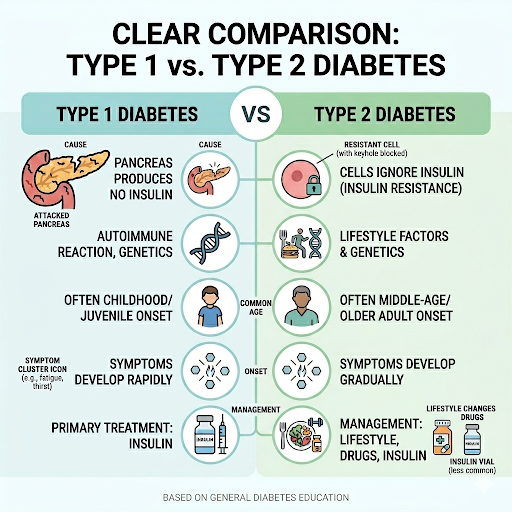
A simple infographic showing the difference between Type 1 and Type 2 diabetes. Image Credit: Gemini.
Diabetes is a condition in which the body cannot properly regulate blood glucose – the sugar that fuels every cell you have. There are two main types of diabetes, which are Type 1 and Type 2 diabetes. In Type 1 diabetes, the immune system destroys the cells that produce insulin, the hormone responsible for moving glucose from the blood into cells. With little or no insulin, sugar accumulates in the blood, and over time, this can affect major organs in the body, including the kidneys, eyes, and skin, and can even lead to death. A person with Type 1 diabetes needs insulin replacement to restore and maintain normal body function.
In Type 2 diabetes, the body produces insulin but uses it poorly. This also causes glucose to accumulate in the blood over time and impairs body function, just like in Type 1. Type 2 is far more common and is often associated with the use of herbal remedies like bitter leaf.
The dangerous reality of diabetes is not how it feels in the early stages; it is what it silently does to your body while you feel relatively well. When your blood glucose is persistently high, some blood vessels may be damaged, leading to major complications in various organs.
For example, in the eyes, it causes diabetic retinopathy, which is the leading cause of preventable blindness worldwide. In the kidneys, it can lead to organ failure, sometimes requiring dialysis or transplantation. It also damages nerves, producing pain, numbness, and wounds that cannot heal, particularly in the feet, which is why diabetes is the leading cause of non-traumatic lower limb amputations globally. It can also significantly increase the risks of heart attack and stroke.
Based on the information released by the World Health Organisation (WHO), diabetes directly caused approximately 1.6 million deaths in 2021, and high blood sugar contributed to millions of deaths from heart disease and kidney failure. According to the WHO Regional Office for Africa, Nigeria has the highest cases of diabetes in sub-Saharan Africa due to unhealthy processed foods high in added sugar, lack of exercise, and use of tobacco, leading to high cases of complications such as blindness, kidney failure, stroke, and amputation.
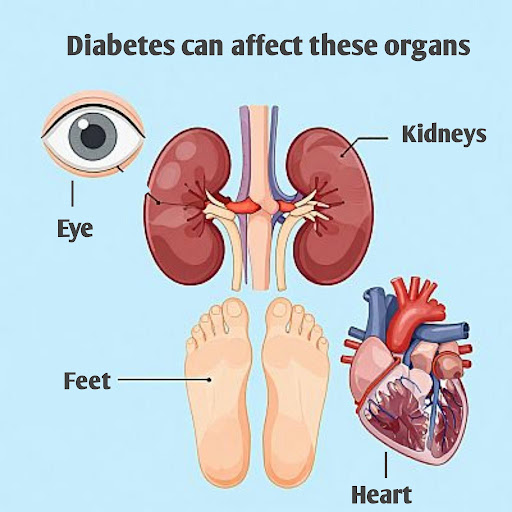
An illustration of the body organs affected by uncontrolled diabetes – eyes, kidneys, feet, and heart. Image Credit: Freepik
The critical point is that these complications are largely preventable, but prevention requires consistently achieving target blood sugar levels, and that is where the conversation about using only bitter leaf to manage diabetes becomes important.
The Truth About Bitter Leaf and Other Herbal Remedies
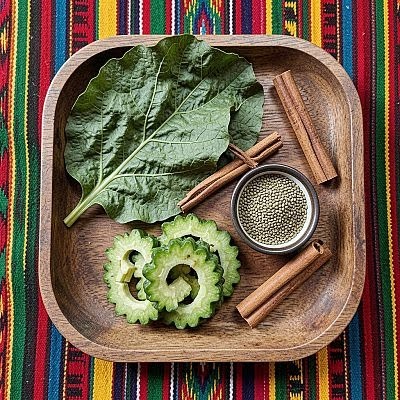
A flat-lay image of bitter leaf, bitter melon, fenugreek seeds, and cinnamon sticks arranged together. Image Credit: Freepik
Bitter leaf (Vernonia amygdalina) is a plant with genuine medicinal properties. It has been used across West Africa for generations to manage a variety of health conditions. Several laboratory and animal studies have found that extracts of Vernonia amygdalina have blood sugar-lowering effects. A 2023 review published in the Journal of Diabetes & Metabolic Disorders shows that bitter leaf contains natural compounds that have some blood sugar-lowering effects. This finding is consistent with other studies that suggest bitter leaf has antidiabetic properties and can improve insulin sensitivity through certain active compounds.
Regardless of these scientific findings, there is a significant difference between “has some blood sugar-lowering effect in studies” and “is sufficient to control diabetes in a living person.” Also, the effects documented in the available research have some limitations.
For instance, the studies are largely small, many were conducted using animals, and dosing is neither standardised nor consistent across products. Most importantly, none of the available evidence suggests that bitter leaf – or any herbal remedy currently studied – can achieve the specific blood sugar targets that prevent diabetic complications in the majority of people living with diabetes.
This insufficiency is further seen in other herbal remedies commonly used to manage diabetes. For example, Bitter melon (Momordica charantia), widely used in South and South-East Asia, has modest evidence supporting its efficacy but no medical trials demonstrating that it can replace medication. Fenugreek also shows a lowering effect on after-meal blood sugar in small studies. Despite its popularity, Cinnamon has little to no proven medical effect on blood sugar. Aloe vera, on the other hand, has limited evidence and potential interactions with prescribed medications.
What herbal remedies can genuinely do is serve as a complementary layer by providing additional benefits when used alongside medical treatment, supporting overall well-being, and maintaining the cultural and psychological connection to traditional healing that many people find meaningful. Bitter leaf and other herbal remedies have real value, but they simply cannot carry the entire weight of diabetes management alone.
Because diabetes does not always feel serious, especially when the individual is using a substance with a certain blood sugar-lowering effect, people believe their herbal remedy is working even when it is not adequately controlling their blood sugar.
A person can have a blood sugar that is higher than it should be and still feel reasonably well. So, when they drink their bitter leaf tea and feel slightly better, they conclude it is working. Meanwhile, blood vessels are being damaged, and although there are no visible symptoms yet, the harm is accumulating quietly.
Why Medical Treatment Is a Must
Diabetes medications work because decades of rigorous medical research have established precisely how they function, at what doses, and with what outcomes. For example, Metformin – the most commonly prescribed first-line medication for Type 2 diabetes – reduces liver glucose production, improves insulin sensitivity, and has a strong safety record based on over 60 years of use. Newer drug classes have been shown in large medical trials not only to control blood sugar but to significantly reduce the risk of heart attack, stroke, and kidney failure in people with diabetes.
According to the American Diabetes Association, diabetes management aims for an HbA1c target of below 7% for most people. HbA1c is your average blood glucose for two to three months. Landmark studies, including the UK Prospective Diabetes Study, have shown that this below 7% target can substantially reduce the risk of major complications associated with diabetes. Every 1% reduction in HbA1c reduces the risk of microvascular complications such as eye and kidney damage by approximately 37%. Medical treatment can achieve and sustain this target, but based on the evidence currently available, herbal remedies alone cannot.
Most individuals opt for herbal remedies and refuse to take medications because of side effects. Medication side effects are a legitimate concern and deserve an honest acknowledgment. For instance, Metformin, which we mentioned earlier, can cause stomach discomfort in some people, especially when newly started, and other medications also carry their own risk profiles.
However, these side effects are, in most cases, manageable as adjusting the dose, changing the timing, or switching to an alternative medication resolves them for most people. But the consequences of uncontrolled diabetes – permanent vision loss, kidney failure, amputation – are not manageable in the same way. Once diabetic retinopathy reaches an advanced stage, sight lost cannot be restored. Once kidney function falls critically, dialysis becomes a life sentence. These risks are not equal to medication side effects.
The Dangerous Middle Ground
One of the most common patterns that leads to serious harm is a simple, understandable thought, like: “I will try the natural approach first. If it does not work, then I will take medication.”
The problem, as we established earlier, is that diabetes damage is cumulative and often invisible. Six months of inadequately controlled blood sugar is six months of damage to blood vessels, nerves, and organs – damage that does not announce itself until it is advanced, and that cannot always be reversed once it occurs.
This means that there is no safe trial period for an approach that leaves blood sugar uncontrolled. The time to achieve good control is now, at diagnosis, not after trying bitter leaf tea.
A better way to add your bitterleaf tea or other herbal remedy is to start medical treatment immediately to establish blood sugar control, and then discuss with your doctor whether complementary traditional approaches can be safely incorporated alongside your medications.
How to Combine Traditional Remedies With Medical Treatment Safely
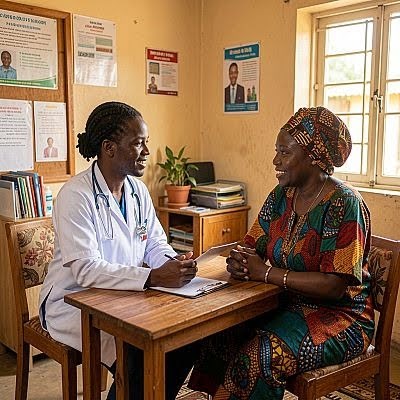
An image of a healthcare provider and patient in consultation. Image Credit: Freepik
The goal is not to choose between your culture and your health, but to protect yourself and your health while using your medications and your herbal remedies where appropriate.
Medical treatments, such as consistently taking your prescribed medications, monitoring your blood sugar as advised, attending regular check-ups, and working toward your individual target blood sugar goal, form the foundation. On top of that foundation, traditional remedies like bitter leaf can be added as a complement – not a replacement.
The most essential step is to inform your doctor, as some herbal preparations interact with diabetes medications. Bitterleaf, for example, may have additive blood sugar-lowering effects when combined with medication, which could cause low blood sugar (hypoglycemia) if doses are not adjusted. Remember that your doctor cannot protect you from interactions they are not aware of. So, an honest conversation, like “I use bitter leaf tea, and I would like to continue,” allows your care to be properly monitored.
In addition to telling your doctor, also remember to track your blood sugar readings when adding or changing any herbal preparation. Share the information with your doctor, and do not assume something is working based on how you feel.
A good doctor will not dismiss your cultural practices, but will instead respect and acknowledge them. However, your doctor is bound to protect your health, so listen to and apply the advice given to you by your health professionals.
Conclusion
Traditional medicines carry centuries of knowledge, community trust, and in many cases, genuine physiological effects that science is still working to verify. Bitter leaf’s effect on blood sugar is not a myth; it is scientifically proven. The problem is that trusting it alone with a condition that demands more than it can currently provide is highly dangerous.
Diabetes complications such as blindness, amputations, and kidney failure are not inevitable. They are, in fact, largely preventable, but prevention requires consistent, measurable blood sugar control that only evidence-based medical treatment can reliably deliver for most people.
You can brew your bitter leaf tea, you can honour the practices your grandmother trusted, you can bring your whole self – your culture, your values, your beliefs – into your diabetes management. Just do not leave your medication behind when you do because your eyes, your kidneys, and your future health depend on both.
Disclaimer: This content is for informational purposes only and is not medical advice. Consult a qualified healthcare professional for diagnosis and treatment.
References
- World Health Organization. (2024, November 14). Diabetes. Retrieved from here
- World Health Organization. (2024, November 18). Prioritise your health by knowing your blood sugar status and living a healthy lifestyle. WHO | Regional Office for Africa. Retrieved from here
- Akerele, G. P., Adedayo, B. C., Oboh, G., & Ogunsuyi, O. B. (2023). Effect of Bitter-leaf (Vernonia amygdalina) Flavored Non-alcoholic Wheat Beer (NAWB) on Insulin and GLUT-2 expression in Pancreas of High-fat diet/Streptozotocin (HFD/STZ) Induced Diabetic Wistar Rats. Journal of Diabetes & Metabolic Disorders, 22(1), 873-880. Retrieved from here
- Kim, B., Lee, H. S., Kim, H. J., Lee, H., Lee, I. Y., Ock, S., … & Choi, Y. (2022). Momordica charantia (bitter melon) efficacy and safety on glucose metabolism in Korean prediabetes participants: a 12-week, randomized clinical study. Food science and biotechnology, 32(5), 697. Retrieved from here
- Kim, J., Noh, W., Kim, A., Choi, Y., & Kim, Y. S. (2023). The effect of fenugreek in type 2 diabetes and prediabetes: a systematic review and meta-analysis of randomized controlled trials. International journal of molecular sciences, 24(18), 13999. Available from here
- Hasanzade, F., Toliat, M., Emami, S. A., & Emamimoghaadam, Z. (2013). The effect of cinnamon on glucose of type II diabetes patients. Journal of traditional and complementary medicine, 3(3), 171-174. Retrieved from here
- Prakash, D., Margaret, J., Subramanian, N. S., Maheshbhai, C. M., Babubhai, C. K., Kiranbhai, C. S., … & Lodha, H. L. K. (2023). Effect of aloe vera juice on type 2 diabetes mellitus among Indian patients. Bioinformation, 19(10), 1015. Retrieved from here
- American Diabetes Association. (n.d.). Health checks for people with diabetes. Retrieved from here
- Stratton, I. M., Adler, A. I., Neil, H. A. W., Matthews, D. R., Manley, S. E., Cull, C. A., … & Holman, R. R. (2000). Association of glycaemia with macrovascular and microvascular complications of type 2 diabetes (UKPDS 35): prospective observational study. bmj, 321(7258), 405-412. Retrieved from here